

severe weight loss after pregnancy
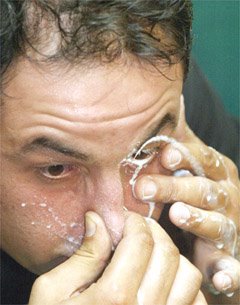 Mehmet Yilmaz snorts milk up his nose and squirts it out of his eye in a bid to set a new world record in Istanbul, Turkey, Wednesday, Sept. 1, 2004. Yilmaz squirted the milk 2 m 79.5 cm, surpassing the existing world record of 2 m 61 cm. (AP/Osman Orsal)
Many people have anatomical tricks that can break the ice at cocktail parties - making a cloverleaf tongue, crossing one eye at a time, pointing your uvula -- but this one pretty much takes the cake.
Theoretically it seems like everyone should be capable of squirting milk from the eyes. After all, we all have nasolacrimal ducts, canals that allow tears to drain from the eyes to the nasal cavity. Thats why people get "runny noses" when they cry. Thats also why we should avoid touching our eyes: viruses on fingers can be transported from the eye via the nasolacrimal duct to the nose and throat (check out the very cool Common Cold website for more information). There are two nasolacrimal ducts - one for each eye - and each duct has two tiny entrances called lacrimal puncta. Using a mirror, look very closely at the inner corner of your eye and youll see that each eyelid (upper and lower) has a lacrimal punctum. Normally fluid goes from the lacrimal puncta to the nose; eye-squirters somehow manage to reverse the flow.
Even though we all have the requisite eye-nose connection, eye-squirting must not be common. Id never heard of it until I read about this guy in 2004. An article on the BBC website (bless them for keeping their news archives free) claims that "only a few people around the world have the necessary physical anomaly." Maybe that means that only a few people have a lacrimal punctum (eyelid hole) that is big enough. Or maybe it just hasnt occurred to most people to give it try.
Not that Id recommend it. The nasolacrimal ducts arent the only structures that drain into the nose. The sinuses do, too. These spaces in the skull (called paranasal sinuses, to be precise) normally contain nothing more than air and a thin film of mucus, but they can become overwhelmed by things like infection, inflammation, and excess mucous production. Thats what happens in sinusitis . I imagine that milk, even if its been pasteurized, isnt good for the sinuses.
Strange as it may sound, milk in the nasal cavity could also end up in the ears. Just behind the nasal cavity is the nasopharynx, the top end of the throat. The nasopharynx has two major claims to fame: it contains (1) a collection of infection-fighting tissue called the pharyngeal tonsil (also called adenoids); and nearby, (2) the openings of the eustachian tubes. The eustachian tubes lead directly to the middle ear. This connection between the ear and the throat is a good thing if youre trying to adjust the air pressure in your middle ear (e.g., when you fly or dive). But its potentially a bad thing for eye-squirters. Milk in the middle ear cavity sounds like a recipe for otitis media.
Finally, if the photo above didnt freak you out enough, check out the video!

Do you find information about severe weight loss after pregnancy are you looking for? If not, below may help you find more information about the severe weight loss after pregnancy. Thank you for visiting, have a great day.


0 komentar:
Posting Komentar